
How to Make Money in Lumber Empire: Upgrade Priorities
Last updated:
Your next useful upgrade depends on where wood stops moving. An empty machine needs more supply; a backed-up line needs a clear route to sales. Spend where the purchase will help your factory turn more wood into income.
Keep logs supplied, process them into more valuable goods, and connect the output to trucks. Improve workers or forests when machines lack materials, add missing conveyors when hauling slows production, and fix truck output before increasing a backed-up line's speed. Budget for complete expansions, collect available rewards, and reconsider expensive upgrades when a rebirth or new production area is your next goal.
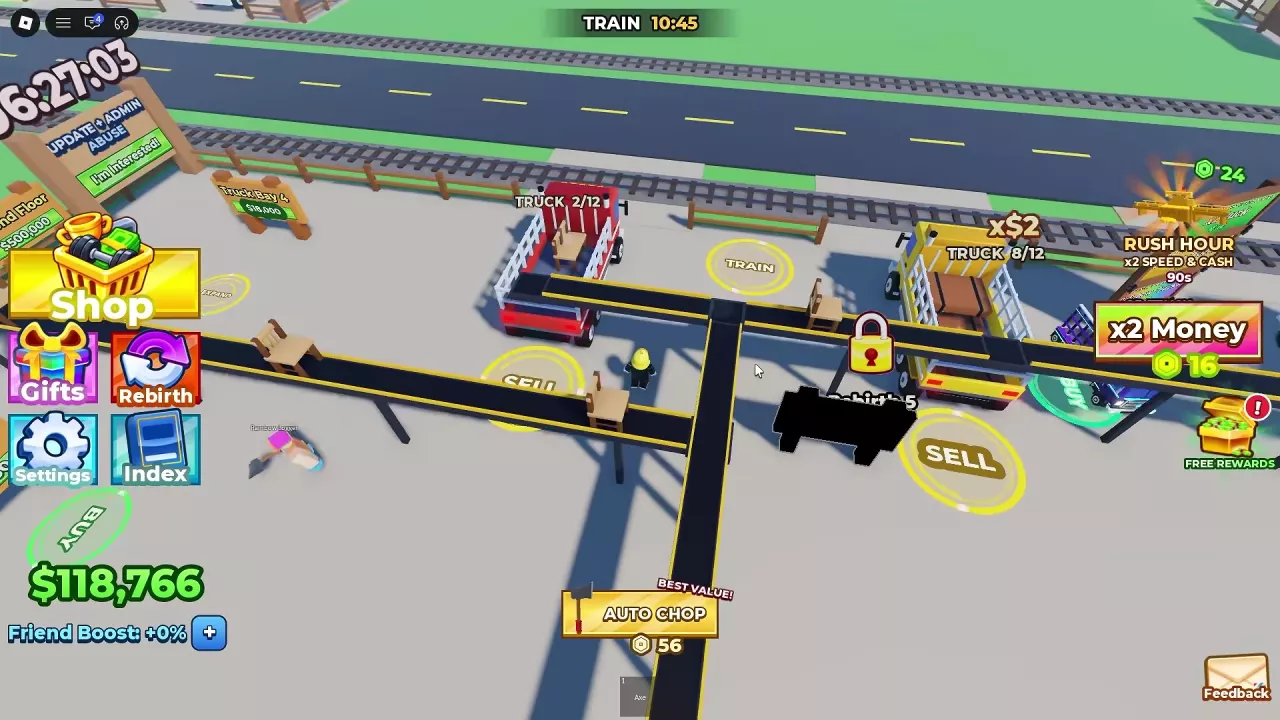
Build Income Around a Working Production Line
Build a continuous path from trees to truck sales:
- Start cash flow with wood sales. At the beginning or after a normal rebirth, improve Player Carry Capacity if repeated trips slow you down, or Axe Power if chopping takes too long.
- Fund processing. Move from raw logs to processed wood, then furniture as facilities become available. Processing adds value to the material you sell.
- Hire workers and connect machines. Workers chop and haul; conveyors move materials between connected stages. Help chop or deliver logs while supply is still thin.
- Connect finished goods to trucks. A production upgrade becomes useful income only when its output reaches the sales end of the line.
Once the connected factory runs steadily while you are in the game, let workers handle routine collection and hauling. Use that time to manage upgrades, prepare train cargo, or visit the airport. The automation guide explains connections and output controls in detail.
Spend on the Stage That Is Slowing Sales
Watch where materials wait before spending your next batch of cash.
| What is slowing the factory? | Next investment or action | Why it fits |
|---|---|---|
| Too few workers supply the machines | Hire another worker if a slot is available | Another hire adds labor. Early hiring prices include $75 for the second worker and $300 for the third. |
| Workers repeatedly carry small loads | Consider Worker Carry | The 1→2 logs upgrade costs $250, compared with $300 for a third worker. Carry targets small-load trips; hiring targets a shortage of workers. |
| Workers move or chop too slowly | Choose Worker Speed or Worker Axe, respectively | Improve the task causing the delay instead of buying an unrelated stat. |
| Workers run short of trees | Consider More Forest, Tree Regrowth, or Tree Luck | More Forest adds trees, Regrowth reduces the wait for replacements, and Luck improves the chance of higher-yield trees. |
| Too much labor goes into hauling between machines | Build the missing conveyor connection | It removes that hauling step and frees workers to supply the line. |
| Products pile up downstream | Check connections and OUTPUT first; then consider truck capacity, delivery time, or another bay | Use NEXT to continue processing and TRUCK for the sales route. More incoming wood will not clear an output blockage. |
| A supplied, connected Debarker cannot keep up | Consider Debarker Turbo for $30,000 | It doubles Debarker speed and targets a processing bottleneck. |
When comparing labor purchases, use the price of your next hire or upgrade. The cheaper early Carry upgrade does not establish a permanent buying order. See worker costs and upgrade choices for labor details and truck upgrades when transport is holding up sales.
Fund Complete Furniture and Floor Expansions
Reserve money for a new facility's input and output connections as well as the building itself. The first Workshop becomes available after Rebirth 1, with these separate purchases:
- Workshop: $50,000.
- Incoming Conveyor: $40,000.
- Truck: Workshop extension: $60,000.
Buying the Workshop alone leaves the transport work unfinished. Keep materials arriving and furniture moving toward trucks before committing more money to tables or beds. Follow the furniture production guide for the complete connection and upgrade sequence.
Apply the same budgeting rule to upper floors. Third Floor requires four rebirths and a separate $25 million purchase, followed by production and conveyor construction. A $2.5 million conveyor purchase point on the new floor is an additional expense, not part of its entry price. Check the floor expansion guide before allocating your construction budget.
If Third Floor is unfinished and you are also considering further Crystal Mine upgrades, a practical route is to get the upper-floor line operating first, then return to the mine. This keeps an unfinished production investment moving toward sales before you spread more money across another area. It is especially useful when completing the floor is already your goal.
Fit Trains, Gifts and Employees into Your Routine
Use the time freed by automation for rewards that supplement regular factory sales:
- Prepare wood before the train arrives. Watch the next-arrival countdown, then deliver during the loading window. The train leaves when that timer ends, so preparing cargo early leaves more time for hauling. Deliveries pay cash and can award an Employee Crate. See the train loading guide.
- Claim ready Gifts. Open Gifts and select rewards marked CLAIM!. Rewards include cash, CRATE rewards, and cash-and-crate bundles. Countdown entries are still waiting; Claimed! entries are already collected. See gift timers and claiming.
- Open Employee Crates you have earned. Select a crate from the hotbar and use it. Aim for an employee with a higher money multiplier than your current best. Rainbow Logger is a x3 option from the ordinary Employee Crate. Compare employee upgrade targets before spending on a specific employee.
When the Halloween event is active, choose Haunted upgrades according to what limits the effect:
- Long wait between triggers: Trees Needed reduces the chopping requirement. The first upgrade costs $1,500 and lowers it from 100 to 90 trees.
- Effect ends too quickly: Haunt Duration extends the active period. The first upgrade costs $1,000 and increases it from 30 to 40 seconds.
These purchases improve how often or how long Haunted applies. The Haunted guide covers triggering the effect and later upgrades.
Separate Sale Bonuses from Processing Speed
Choose bonuses by the material, sale, or production stage they affect.
| Bonus or upgrade | Effect and scope |
|---|---|
| Rebirth multiplier | The first rebirth gives a x2 sales multiplier; the second gives x3. These are resulting stage multipliers, so earlier stages are not multiplied together. |
| Best owned employee | All hired workers automatically use your best owned employee. Rainbow Logger provides x3 money when it is your best; employees do not need separate assignments. |
| Haunted | During the Halloween event, logs produced by affected trees sell for twice their normal value. |
| Airport wood | Pine carries a x2 label and Maple a x3.8 label. Each belongs to that wood type, with procurement costs and flight time to consider. |
| Third Floor Rainbow Wood | Its posted sale value is 5x. This applies to Rainbow Wood. |
| Lucky trucks | Gold trucks provide x2 earnings, with a listed 15% chance; Rainbow trucks provide x5, with a listed 5% chance. The Gold Truck bonus applies to cargo loaded onto that truck. |
| Permanent x2 Money | Doubles income from each sale. The x2 offer costs 16 Robux; after purchase, the next offer is labeled x4 Money. |
| Full truck load | Loading cargo can pay before the truck fills. Completing the load adds a separate bonus. |
| Debarker Turbo | Doubles Debarker processing speed. |
| Golden Machines | Permanently makes all machines process at three times their speed. |
Machine speed helps when a machine has materials waiting and room to send its output onward. It does not directly multiply an item's sale price, and a faster machine cannot solve an empty input or blocked output. Likewise, a full-load reward is separate from the payment for an individual item.
For paid purchases, choose Golden Machines for a processing bottleneck, x2 Money for more income per sale, or Auto Chop to reduce manual chopping by automatically chopping the nearest tree wherever your character is. Compare the paid upgrade choices by the task you want to improve.
Reassess Rebirth and Late-Game Spending
Before another rebirth
Once you meet the cash requirement, rebirth if your next goal is the new stage multiplier, worker slot, or facility unlock. A normal rebirth clears current cash and the plot, so weigh a large new construction purchase against how soon you intend to reset. Delay the reset if you want to keep using your current factory.
Plan to restart wood sales, rehire workers, and restore the production connections you need. The rebirth guide lists requirements, reset consequences, and unlocks.
When investing in the airport
Reserve funds for a plane and its log purchases. With the initial 30-log Crop Duster setup, Pine Valley costs $450 and takes 60 seconds; Maple Ridge costs $1,200 and takes 150 seconds. Pine suits a smaller budget and shorter return cycle. Maple offers the higher wood label shown above, with a larger procurement bill and longer flight.
Choose Flight Speed when waiting on trips, Cargo Hold when you want larger shipments, or Log Price when reducing procurement cost is the goal. Keep that spending aligned with your factory's ability to process and sell the incoming logs. The airport guide covers planes, routes, and dispatching.
When worker upgrades become expensive
Worker Carry costs $65 million for 6→7 logs and $1 billion for 7→8 logs. Compare those purchases with unfinished production, truck connections, and airport investments. For another price reference, hiring the eighth worker costs $900,000 if you have the available slot.
Buy the next Carry level when small loads still constrain your working line. If goods are waiting at a missing connection, complete that route first. A useful early upgrade can become a lower priority once its next price rises sharply.